CameraLabs: Sony a7RIV In-Depth Review

Godran finished his Sony a7RIV review and it a long one. Overall he sounds impressed by the value and below you can find excerpts from the video:

  • New Weather sealing
  • The new exposure composition lock is nice
  • The buttons are larger and feel better
  • Would like backlit buttons
  • Moving the back scroll wheel to the top feels better to Gordon
  • More room between lens mount and grip which is welcome
  • UHS-II for both slots is nice and should have been the case before
  • The new smart hot shoe is useful with the new shotgun mic
  • Hopes the new hot shoe is on other cameras
  • Samer wired connectivity as before
  • Still Bluetooth and wifi, but wifi now has 5ghz too
  • Z battery is great still
  • Sony has one of the longest battery lives around
  • The grip lets you use two Z batteries
  • The 5.76MP OLED EVF looks amazing in use
  • The back screen is still very much the same and only angles up or down
  • Would like it to angle out or flip
  • The touch interface is still poor and hasn’t been improved
  • Playback doesn’t let you swipe or zoom
  • Interval timer built-in
  • Larger denser AF than ever before with 567PDAF over 74% fo the frame in a square area
  • Crop mode has 325PDAF points covering the entire frame with 27MP images
  • -3EV AF
  • Real-time eye AF for humans and animals
  • AF is so good that you can trust it to automatically work unlike others
  • Eye AF works in movies and should have been available in other models
  • 10FPS for 68 frames
  • Continuous eye AF works very well
  • Can be used for sports/action/wildlife without an issue
  • The interface is like the a7RIII
  • Specs the same as a7RIII
  • Super 35 is the best way to use if to video like the previous camera
  • 4k up to 30p
  • The camera uses 6k of data instead of 5k like the previous
  • 4k super 35 24p is 1.6x crop and 1.8x crop for 30p
  • 1080p up to 60p and 120p with sound and AF
  • Sony has very flexible slow motion
  • No 10-bit or 60p etc…
  • Best phase-detection around for video
  • The new 61MP BSI Full Frame sensor leapfrogs its rivals
  • The camera still uses basically the same IBIS that gives 5.5 stops of stabilization
  • Great for very large prints and crops
  • When comparing the old and new model Gordon found that there is a visible increase in detail up till 400 ISO where there is more noise
  • By 1600ISO there is almost no difference between the a7RIII and a7RIV and by the highest value you could argue the a7RIII is better
  • You should shoot the a7RIV at below 400ISO to fully benefit
  • a7RIV JPEG engine does a good job keeping images clean up to 1600ISO
  • The upgraded pixel shift can give you a lot more resolution
  • Pixel shift photos still need special software
  • You don’t get quadruple the detail with pixel shift, but it’s good for archiving still subjects
  • Subject and technique matter a lot
  • Nonobvious things move in pixel shift like foliage in the breeze so it’s best to use indoors
  • Should be able to process pixel shift images in the camera
  • When pixel shift works you won’t get 240MP, but there is certainly more than 61MP for the right subjects
  • The a7RIV is an impressive body that brings a lot of speed and handling to tempt D850 owners
  • The body tweaks are welcome
  • Still frustrated with the touch screen and video not being upgraded
  • The new mic is great for video shooters
  • If you want video the LUMIX S bodies are better
  • Overall he recommends it, but if 42MP is enough then look for a deal on the Sony a7RIV

Follow SonyAddict on FacebookTwitterInstagram, and YouTube

Sony a7RIV: B&H Photo / Amazon / Adorama
Sony RX100VIII: B&H Photo / Amazon / Adorama
Sony VG-C4EM grip: B&H Photo / Amazon / Adorama
XLR-K3M Mic Input: B&H Photo / Amazon / Adorama
ECM-B1M Digital Audio Shotgun Microphone:
B&H Photo / Amazon / Adorama
Posted in Sony a7RIV| Leave a comment

Clarifying The Sony LA-EA1, LA-EA2, LA-EA3, and LA-EA4

Sony has a lot of great new and used Minolta A-Mount glass that is being forgotten about as more Sony photographers more to E-mount from Sony’s legacy A-Mount standard. Sony’s A-Mount translucent mirror technology has always interested me and when it was introduced there was a lot of value in Sony’s lens line up, but I decided to go m43 around that time since it was truly mirrorless and compact.

Now prices are still high for new A-Mount glass, but if you look carefully there are some great used values that should only get better with time as more photographers switch to native E-Mount glass. There are a variety of reasons why a photographer might switch their A-Mount to E-mount glass, but if you choose your adapters wisely switching to native E-Mount glass is less of an advantage than you might think.

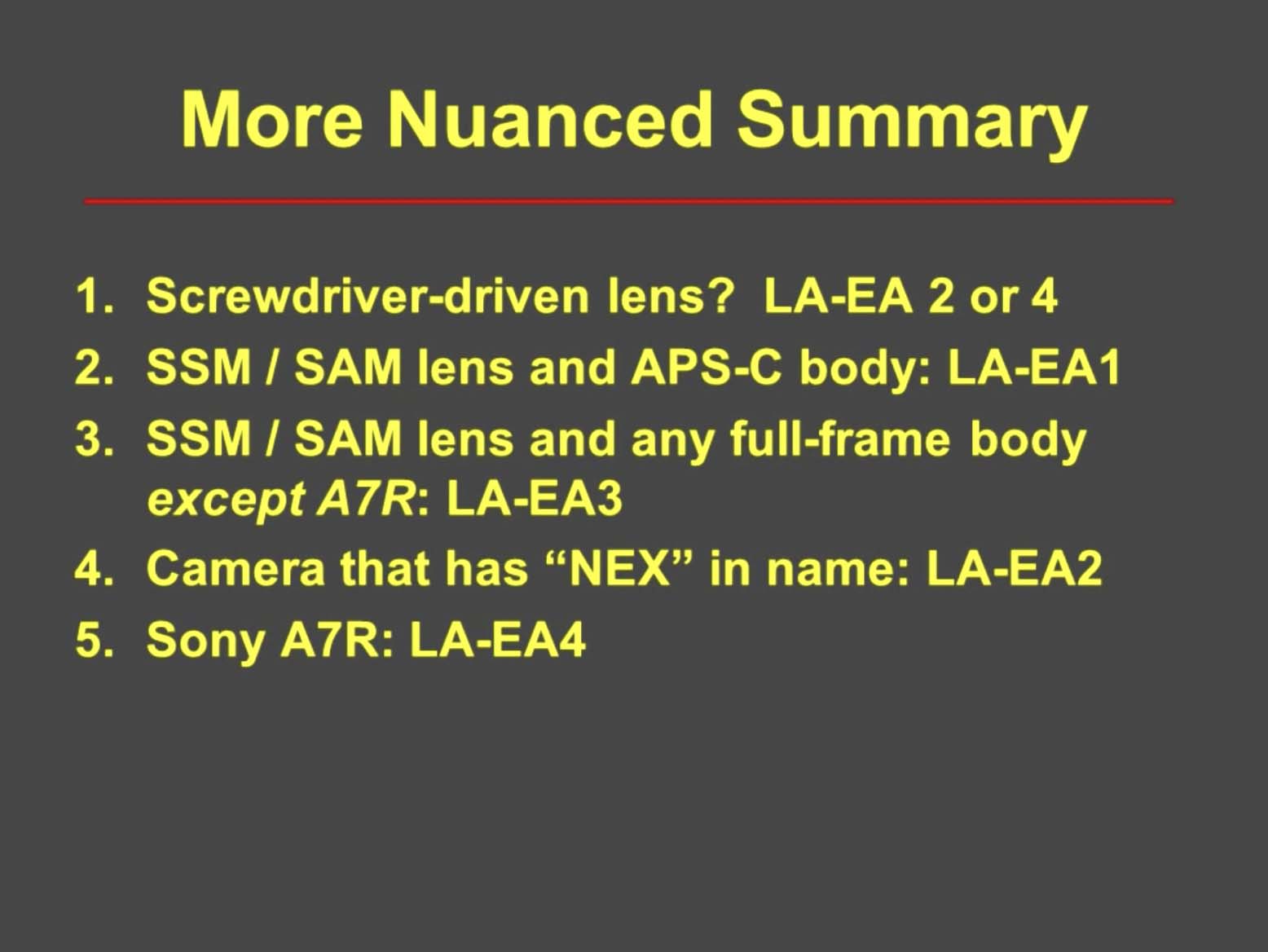
In my estimation, Sony’s adapters that come with a screw drive and translucent mirror are the best option, but if your camera has on-chip PDAF the translucent mirror becomes useless beyond having a screw drive motor in it, but that is the cursory explanation. For a more nuanced explanation watch the video above to see how the Sony LA-EA1, LA-EA2, LA-EA3, and LA-EA4 operate differently and the video below to see how they perform when shooting video.

Posted in Sony E-mount adapters, Sony lenses| Tagged , , , , , , , , , , | Leave a comment

Tamron 17-28mm f/2.8 Di III RXD FE Review

Dustin Abbott posted another of his lengthy reviews that is broken up into three parts about the Tamron 17-28mm f/2.8 Di III RXD FE. Below are excerpts from the videos:

  • The 17-28mm is well built and very light
  • Fully weather sealed
  • Very well designed
  • Not great for manual video
  • Video AF is good and silent
  • Great AF overall and it is one of the quietest lenses Dustin has ever used
  • There is some strong budge/barrel distortion and vignette at 17mm, but it is well corrected in JPEG and easy to correct the RAW
  • For real-world landscape, there isn’t much distortion or bulge so it gets better when the focal point is distant
  • The Tamron is very sharp at the center of the frame with good contrast wide open
  • Tamron is pretty good in the corners wide open, but a little soft
  • At f/5.6 the center is spectacular and it sharpens up in the mid-frame and corners
  • Once you get to 20mm there is a little pincushion distortion and vignetting gets much better
  • The Tamron at 20mm looks excellent at the center and the midframe and corner is performing well wide open
  • 20mm at f/5.6 fantastic center and mid-frame with the corners looking good
  • 24mm has a little pincushion and vignetting is not an issue
  • 24mm looks very good at f/2.8, but the resolution does get a hair better at f/5.6 very good result overall
  • 28mm is a little wider on the 17-28mm than on the 28-75mm lens
  • The 17-28mm has a little pincushion distortion at 28mm
  • The 17-28mm is fantastically sharp at 28mm, but the 28-75mm is a little sharper
  • There is a little softness on the 17-28mm and 28-75mm at the corners
  • At f/5.6 both Tamron’s are sharp in the middle, but the 28-75mm shows some more contrast
  • The extreme corners at f/5.6 are good, but not excellent
  • This lens is well designed for landscape photography because infinity focus has minimal issues
  • The Tamron 17-28mm has lots of micro-contrast and pop at infinity wide open and stopped down
  • A little ghosting pattern with the Sun in the frame, but the contrast is still solid and it makes the image look more artistic
  • Starbursts are good and bokeh is pretty good
  • Image quality is solid at 28mm up close
  • Crisp star points for Astro with minimal chroma problems
  • Good lens for Astrophotography at 17mm, but not exceptional
  • Chroma is a hair worse at 28mm
  • 17mm can focus closer than 28mm and contrast and resolution are great here
  • 28mm close focus has a little less magnification, but the contrast drops off a little
  • Hopefully, we will see a lens profile for 17-28mm RAW files from Adobe soon
  • Video is corrected in-camera for distortion and vignetting
  • The only comparison the Tamron lost was against the 28-75mm Tamron at 28mm
  • The Tamron 17-28mm and 28-75mm can replace a lot of prime lenses
  • Had a few AF glitches that require the camera to be reset so might need a fix like the 28-75mm
  • The 17-28mm cost less than half of what Sony’s wide zoom G master does and it’s even less than what Sony’s f/4 wide zoom costs while offering superior performance

Be sure to follow us on FacebookTwitterInstagramYoutube.

Tamron 17-28mm f/2.8 Di III RXD FE: B&H Photo /  Amazon / Adorama
Tamron 28-75mm f/2.8 Di III RXD FE: B&H Photo / Amazon / Adorama

Posted in 3rd Party Lens| Tagged , , , , , , , , , , , | Leave a comment

Tamron Will Announce Four New Mirrorless Lenses Coming Soon


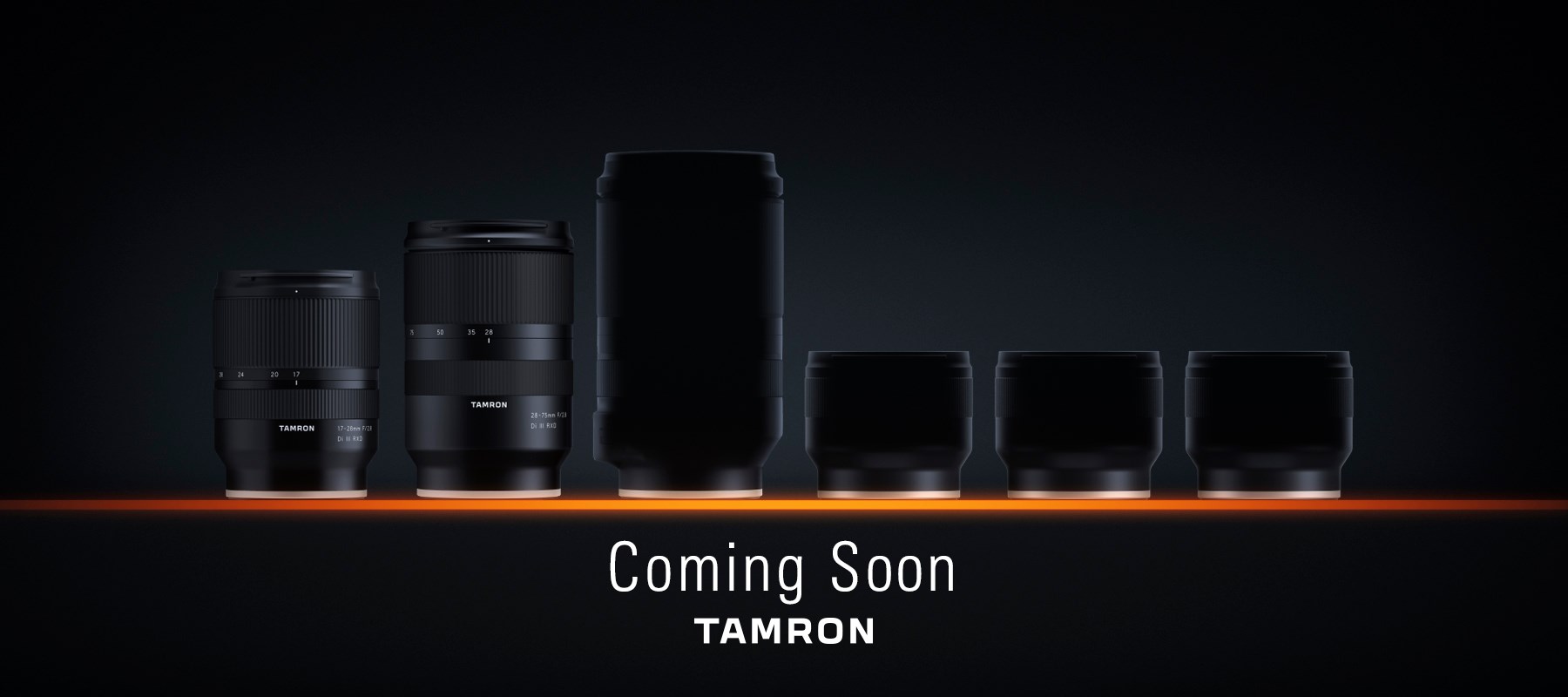
Tamron posted some teasers to their social media that hints at 3 new mirrorless lenses coming soon. It looks like one will be a telephoto/zoom maybe a 75-210mm along with 3 prime lenses. If they release a 70-200mm type zoom for e-mount than they will complete their lineup with the 17-28mm, 28-75mm, and a 75-210mm. Tamron zooms have been incredibly popular on E-mount and are still often sold out.

Be sure to follow us on FacebookTwitterInstagramYoutube.

Tamron 17-28mm f/2.8 Di III RXD FE: B&H Photo /  AmazonAdorama
Tamron 28-75mm f/2.8 Di III RXD FE: B&H Photo / Amazon / Adorama

https://www.facebook.com/TamronLensesUSA/videos/672671209809959/

via Photorumors

Posted in 3rd Party Lens| Tagged , , , , , , , , , , , , , , , , , , | Leave a comment

NEW Viltrox 23mm f/1.4, 33mm f/1.4 and 56mm f/1.4 Autofocus Lenses Posted on Weibo

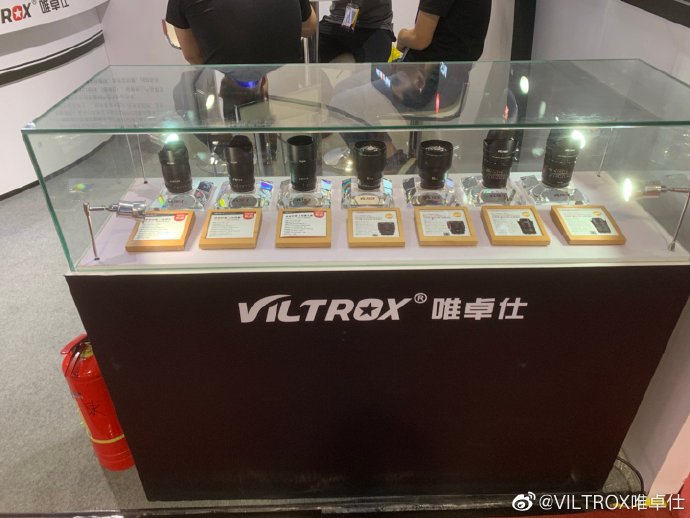
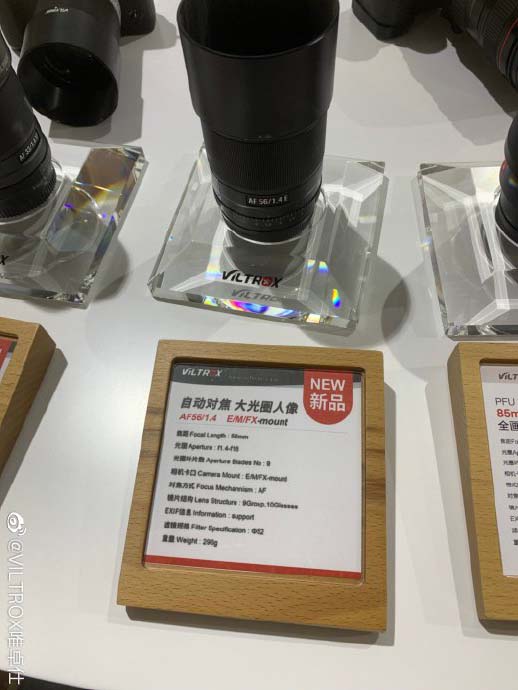
Viltrox posted three new AF lenses to their official weibo which is making the rounds. Above you can see the unaltered photos and their specs are listed in each photo, but below is you can see the specs. It’s interesting that Viltrox is trying to have a consistent front filter size with its fast mirrorless AF glass. You can find Viltrox Glass on Amazon and we should see these lenses soon.

Viltrox 23mm f/1.4

  • Aperture Range: 1.4 – 16
  • 9 Aperture Blades
  • 10 Groups, 11 Glasses
  • Filter Size: 52mm
  • Weight 250g

Viltrox 33mm f/1.4

  • Aperture Range: 1.4 – 16
  • 9 Aperture Blades
  • 9 Groups, 10 Glasses
  • Filter Size: 52
  • Weight 270g

Viltrox 56mm f/1.4

  • Aperture Range: 1.4 – 16
  • 9 Aperture Blades
  • 9 Groups, 10 Glasses
  • Filter Size: 52
  • Weight 290g

VILTROX 85mm f/1.8: B&H Photo / Amazon
VILTROX 56mm f/1.4 (Coming Soon): B&H Photo / Amazon
VILTROX 33mm f/1.4 (Coming Soon): B&H Photo / Amazon
VILTROX 23mm f/1.4 (Coming Soon): B&H Photo / Amazon

via FujiAddict

Posted in 3rd Party Lens| Tagged , , , , , , , , , , , , , , , , , , , , | Leave a comment

Kai on The Sony ECM-B1M Shotgun Mic

Kai compares the new Sony ECM-B1M Shotgun Mic and Rode Shotgun Mic and it holds up surprisingly well. It’s interesting that Kai thinks the ECM-B1M is being under-covered because I have seen a lot of reviews out there but to vlogers the new Sony ECM-B1M should be as exciting or even more exciting than the Sony a7RIV announcement. Now Sony just needs more cameras for the Sony ECM-B1M to work with, which we should see soon.

Follow SonyAddict on FacebookTwitterInstagram, and YouTube

Sony a7RIV: B&H Photo / Amazon / Adorama
Sony VG-C4EM grip: B&H Photo / Amazon / Adorama
XLR-K3M Mic Input: B&H Photo / Amazon / Adorama
ECM-B1M Digital Audio Shotgun Microphone:
B&H Photo / Amazon / Adorama

Posted in Accessories, Sony a7RIV, Sony a7SIII| Tagged , , , , , , , | Leave a comment