EXPERIENCE KANDO TRIP 2.0


Sony Opens Up Registration for One-of-a-Kind “Kando Trip” Photography Event

Immersive “Kando Trip” Experience will feature extensive educational workshops, shooting opportunities, camera and lens trials and much more

SAN DIEGO, Jan 25, 2018 – Sony Electronics, a worldwide leader in digital imaging and the world’s largest image sensor manufacturer, has announced today that they are opening up their flagship “Kando Trip” photography experience to public applications.

The event will take place May 9-12th at beautiful oceanfront Asilomar Conference Grounds in Monterrey, CA. The 4 day, 3 night, all-inclusive experience will offer attendees a choice of over 20 interactive classes and workshops covering many different genres of photography, video storytelling, business and social media best practices, software and hardware tutorials from partner sponsors and more. Additionally, there will be shooting sessions at several iconic locations along the Monterey/Big Sur coastline, keynote speakers, product feedback sessions, contests, giveaways and many other fun activities. Throughout the event, attendees will have access to loaners and trials of all of Sony’s most popular cameras, lenses and accessories.

“‘Kando’, a term near and dear to our hearts at Sony, can be translated to ‘the power to stimulate an emotional response’, or ‘to make people say ‘Wow”,” said Neal Manowitz, Vice President of Digital Imaging at Sony Electronics. “We are continually striving to deliver ‘Kando’ with everything that we do – every product, service, activity and campaign. ‘Kando Trip’ is the ultimate representation of this concept. It’s an event exclusively designed for our community – a chance to for us all to interact, learn and grow together, with ‘wow’ experiences waiting around every corner.”

The experience will feature a variety of classes led by many of Sony’s brand evangelists from the Artisans of Imagery and Alpha Imaging Collective programs, with a common goal of allowing attendees to develop both their photography and their careers. Throughout the event, there will also be opportunities to meet, share ideas and give feedback to Sony’s engineering, product planning, marketing, and business teams, all of which will be in attendance.

To apply for this event, please visit www.AlphaUniverse.com/kandotrip. Spaces are limited.
Posted in Press releases| Leave a comment

DC.Watch Sony G Master Interview (Part 2)


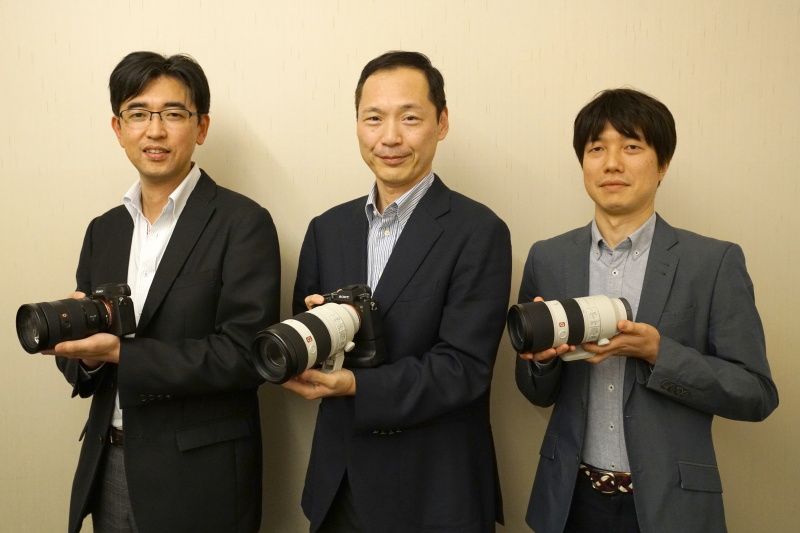
DC.Watch had the opportunity to speak with Sony about their G series of lenses and below you can find some excerpts from part two of the interview. You can find part one here. Since the interview is translated I will do my best to clear up the language.

  • Customers the shoot portraits often assign Eye AF to the focus hold button on the lens
  • G Master lenses are tuned for photography and videography
  • Photography and videography AF are very different algorithms
  • They suppress changes in angle of view on G Master lenses because they appear unnatural in video
  • Many use manual focus for movie production in addition to photography
  • Sony doesn’t design G Master lenses with size/weight restrictions in mind beyond them being reasonable. Optical performance comes first.
  • Originally they tried to stay below 77mm, but they ended up going up to 82mm so they wouldn’t have to bend the light in ways that would affect optical quality.
  • Would only increase the size of the lens to increase resolving power.
  • Resolution and blur tend to not be compatible and the more resolution you add the harder the blur becomes.
  • The ideal point where resolution and blur quality meet is hard to hit and that’s why there has to be very tight manufacturing standards.
  • Sony thinks they can hit 50 lines per mm when most only hit 30 lines per mm.
  • Sony tries to raise high-frequency and low-frequency MTF, but it can affect sharpness or blur.
  • You can’t compare the quality of film lenses and digital lenses.
  • 100mm and 85mm lenses are designed to have optimal blur at portrait focal lengths.
  • It is now possible to simulate the designs to achieve the best balance.
  • Blur simulation lets the camera side characteristics be examined instead of a point like on a spot diagram.
  • The Right side is an example of what G Master lenses aim for.
  • It’s only an example but “the shape of blur changes according to the distance to the subject and the positional relationship with the background, we will make delicate balancing so that the blurred image becomes close to the ideal at any distance”
  • There is an emphasis on getting blur right at closer distances than infinity.
  • Sony accuracy of curved surface and surface roughness are “orders of magnitude higher than conventional aspheric lenses with high precision.”
  • These are being produced at Sony Global Manufacturing & Operations Co., Ltd., Kota site and use proprietary methods.
  • More diaphragm blades aren’t the answer for better bokeh and can cause resistance.
  • Sony uses linear motors and magnets in there AF system that are optimized for the specific G Master lens.
  • “Currently adopted methods of actuators are the ring drive SSM, and the linear motor we introduced, and the direct drive SSM (DDSSM). DDSSM is a driving method based on ultrasonic vibration, but it is a motor that generates driving force directly in the straight direction rather than generating driving force in the direction of rotation like the ring drive SSM. Since it is unnecessary to convert rotational motion into linear motion, unnecessary load of the driving member can be minimized, and a focus driving structure with high speed and very responsiveness can be realized.”
  • DDSSM is driven by ultrasonic vibration, while the linear motor is driven by electromagnetic force, but both are considered linear motors.
  • “The optical merit of floating focus is that you can achieve a high level of image quality from infinity to close up.”
  • “By moving two focusing units independently, you can shorten the shortest shooting distance and further improve the image quality in the immediate vicinity.”
  • “100-400 mm has two systems in front and behind, but they are driven using completely independent actuators, respectively.”
  • The 100-400mm has DDSSM on the front side and double linear motor on the back side.
  • “moving multiple lightweight focus groups is more advantageous in terms of responsiveness than moving one heavy focus group”
  • “control of two focus units must be perfectly synchronized and controlled, just because one focus unit is misaligned will make it impossible to focus”
  • “In telephoto lenses, the correction amount of camera shake increases, so it is often advantageous to incorporate a camera shake correction mechanism on the lens side.”
  • “When there is a camera shake correction mechanism on the lens side, basically rolling (direction of rotation) and shift shake are compensated to some extent, such as correction on the body side.”
  • Magnesium alloy was used inside the 100-400mm to keep weight down and is an example of how G Master lenses don’t compromise.
  • The anti vibration unit from the 100 mm STF was used in the 100-400mm.

Read More »

Posted in Sony Interview| Leave a comment

SonyPixelShiftt2DNG (beta): Convert Sony A7R-III Pixel Shift Files to DNG


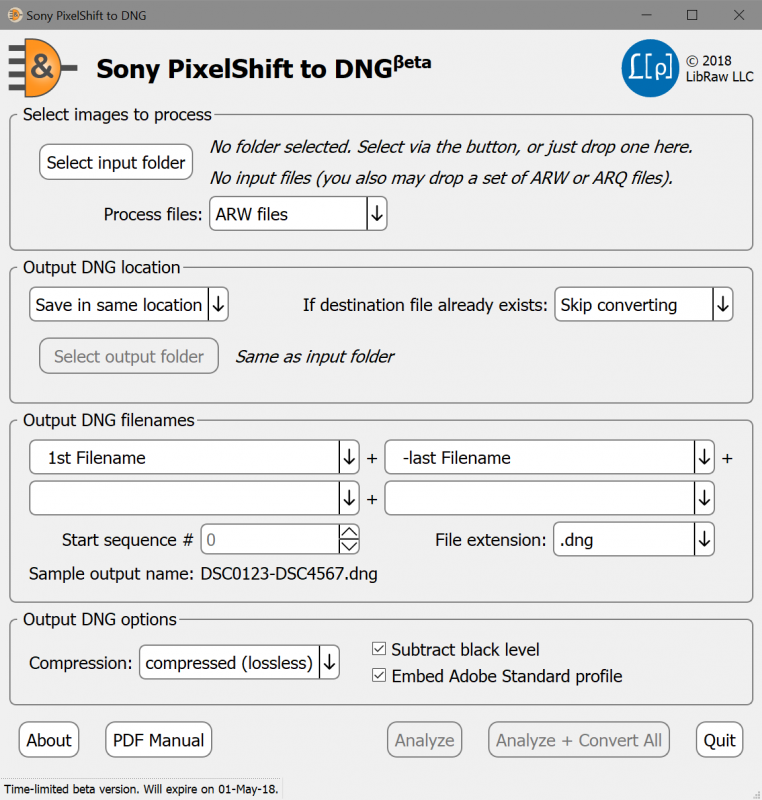
SonyPixelShiftt2DNG looks like an interesting solution to the lack of Pixel Shift support in Lightroom and other applications, but I am curious to see how the files perform once combined into the DNG format. You can read the release notes below and download the application here.

In order to streamline the workflow with the raw shots taken in the new Pixel Shift Multi Shooting mode offered by the new Sony A7R-IIIcamera, and provide a way to use popular RAW converters (Adobe Camera Raw/Lightroom, Capture One, and some others) for processing these shots, we’ve developed the SonyPixelShift2DNG application, which converts Sony A7R-III shots taken in Pixel Shift mode to DNG, supported by most (but not all) programs that process RAW files.

SonyPixelShift2DNG performs the two following tasks:

  • Combine 4 source ARW files taken in Pixel Shift Multi Shooting mode and save the result as a DNG;
  • Convert the ARQ files resulting from Sony’s Imaging Edge Viewer software (so, already-combined quartets of ARW files) to DNG

The resulting DNG files can later be processed in familiar applications like Adobe Lightroom and Camera Raw, CaptureOne, Iridient Developer, Luminar, and others.

via fastrawviewer

Posted in Software, Sony a7RIII| Leave a comment

From Nikon to Canon to Sony: 50 Years of Photojournalism Leading to Sony

David Burnett started his career in photography using Nikon cameras, before selling all of his gear for Canon. Now 40 years later he is dumping Canon for Sony. It sounds like the Sony a9 was a major influence on his decision to dump Canon and even he thinks that he will have plenty of extra frames to choose from with the irresponsibly fast Sony a9. David also sounds very impressed by the Sony a7RIII and mentions that he will be shooting at the 2018 Olympics in Korea with his new cameras.

It is interesting how many professional photographers have done videos about going mirrorless in recent months. It almost seems as if Canon and Nikon might have missed the boat entirely on the move to mirrorless because there are a few mature mirrorless options available today and it took time for them to get that way. I don’t think that Canon and Nikon can release professional mirrorless cameras an get it right immediately to catch up with the competition, so the makeup of the camera market might be changing quite a bit in 2018.

Posted in Sony a7RIII, Sony a9| 1 Comment

Fixing Sony’s Menus…

Very few will try to defend Sony’s menus and Maarten Heilbron’s video about how to fix them has gone a viral, but beyond his desire to consolidate parts of the menu I don’t agree with his suggestions. Sony’s current left/right navigation allows you to navigate tabs very quickly beyond the pages within them. If Sony were to make the changes he suggests about navigation than the consolidation Maarten suggests would be negated by slower navigation of the pages and tabs.

Further many really don’t like touch screens and leave the feature turned off. I haven’t used a camera with good touch screen controls yet and that includes cameras like the Leica TL, which is very smartphone-like and the closest to a good touchscreen interface on a camera yet. I am sure someone will get touchscreen camera interfaces right in the future, but beyond pinch to zoom, I am not interested at this time.

In my opinion, I think Sony needs to more logically consolidate their options like Fujifilm and they need more physical controls similar to Fujifilm cameras. The Sony a9 was a good start and it’s handling is far superior to the Sony a7RIII thanks to the extra added controls, but the menus are still a mess. The difference being that the added physical controls allow you to almost never have to dive into the menus on the Sony a9, whereas the Sony a7RIII requires the user to dive into the menus to make adjustments to things like AF. Here is where fanboys point out the quick menu, but I hate quick menus and I do not use them on my Fujifilm cameras either.

Sony could greatly improve their cameras going forward simply by updating their firmware, but it’s highly unlikely. It took years of unhappy photographers to get the current menus, which aren’t much better than the old menus. Sony isn’t very responsive about their menus being poorly designed for whatever reason and it is a shame since their current generation of cameras are a substantial step ahead of their competitors.

Posted in Editorial| Leave a comment

Kai 5 Reasons Why You Might Need a New Sony RX0

Kai does his best to say the Sony RX0 isn’t an action camera while testing it as an action camera in this odd video that sounds like a poorly planned out marketing ploy. Generally, I enjoy Kai’s quirky reviews and lists, but Kai’s 5 reasons why video isn’t very clear and he continues comparing the Sony RX0 to the GoPro like many other vloggers.

By now everyone should know the Sony RX0 isn’t an action camera or GoPro competitor. Sony makes other action cameras to compete with GoPro. The RX0 is a very specialized tool for a very specific group of videographers and if you don’t fall into that category than you are probably going to be disappointed by the Sony RX0. Maybe the Sony RX0 Mark II will add internal 4k and stabilization so that it suits more people needs, but that’s a while off.

Sony RX0: B&H Photo / Amazon / Adorama
GoPro 6: B&H Photo/Amazon/Adorama
Sony FDR X3000: B&H Photo/Amazon/Adorama

Posted in Sony RX0| Leave a comment