


Sony A7RVI: B&H Photo / Amazon / Adorama
Sony a7RV B&H Photo / Amazon / Moment / Adorama
Sony a7V: B&H Photo / Amazon / Adorama
Fujifilm GFX100II: B&H Photo / Amazon / Adorama
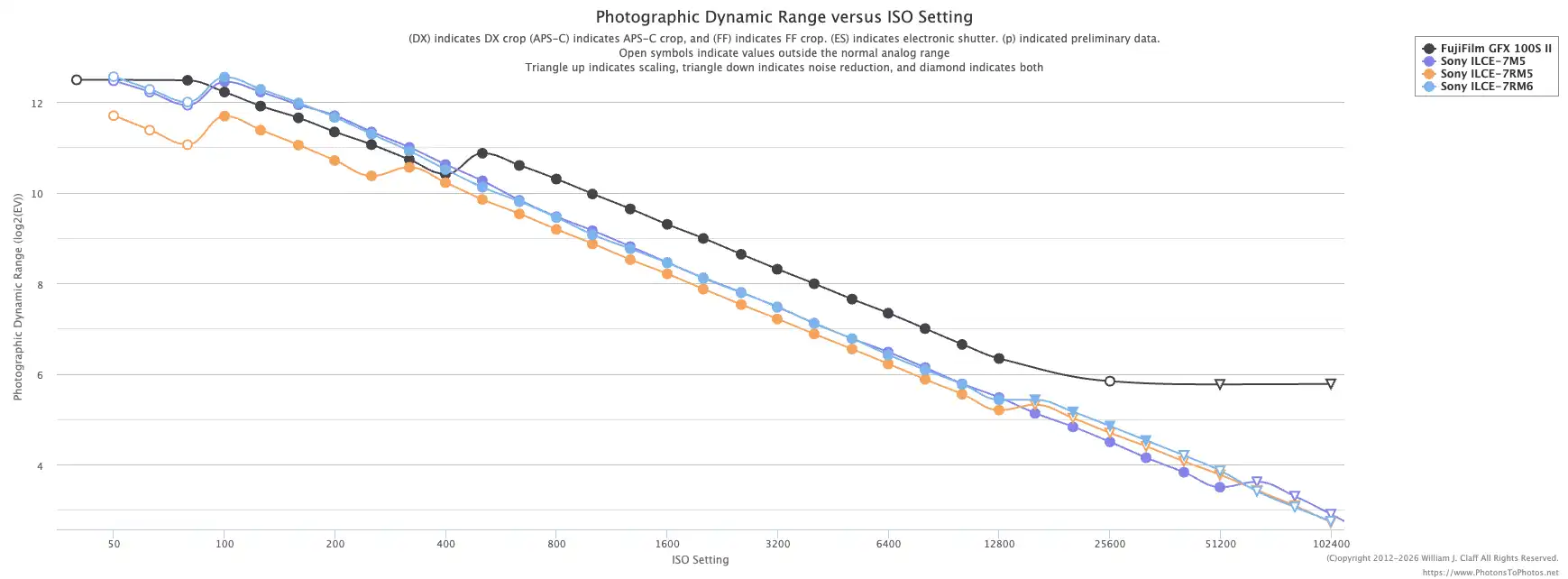
Photons to Photos published its PDR results for the Sony a7RIV, and they are quite impressive, meeting or beating the performance of the medium-format Fujifilm GFX100II at low ISO. You can manipulate the results here or check out more about them below:
| Camera Model | Maximum PDR | Low Light ISO | Low Light EV |
|---|---|---|---|
| FujiFilm GFX 100 II | 12.55 | 11665 | 11.87 |
| Sony ILCE-7RM6 | 12.56 | 6072 | 10.92 |
| Sony ILCE-7RM5 | 11.70 | 5244 | 10.71 |
| Sony ILCE-7M5 | 12.47 | 6303 | 10.98 |
These impressive results are due to Sony’s new DGO sensors, which dramatically improve dynamic range.
Sony’s implementation of Dual Gain Output (DGO) in the a7V and a7VI bodies represents a significant departure from standard dual conversion gain sensors. Rather than switching the entire sensor to a higher-gain circuit at a specific ISO threshold, the partially stacked and fully stacked sensors in these new bodies read the electrical charge of each pixel twice during a single exposure. The first readout operates at a high amplification step to pull ultra-clean detail out of deep shadows, while the second occurs at a low amplification step to protect bright highlights from clipping to pure white.
The BIONZ XR image processor then instantly merges these two parallel readouts into a single, highly malleable RAW file. Because this dual-read process happens within the incredibly short duration of the mechanical shutter actuation, the resulting image is free of the motion blur or ghosting typically associated with multi-shot HDR bracketing. By synthesizing the exceptionally low noise floor of the high-gain circuit with the massive highlight retention of the low-gain circuit, Sony has pushed the dynamic range of the a7V and a7VI into medium-format territory—delivering nearly 15 to 16 stops of usable exposure latitude at base ISO.
There is a physical limitation when shooting fast action. To successfully capture the dual readout, the camera requires the slightly slower transit time of the mechanical shutter. When switching the a7V or a7VI to the electronic shutter for blackout-free tracking or maximum 30fps burst rates, the sensor readout speed is simply too fast to perform the double gain scan, causing the camera to revert to a standard dynamic range curve. However, for landscape, studio, and high-contrast commercial work where the mechanical shutter is preferred, the DGO architecture allows you to expose for harsh highlights and aggressively lift shadows in post-production with virtually zero noise penalty.
Follow SonyAddict on Facebook, Twitter, Instagram, and YouTube
Plus, our owners’ groups
Sony a1 Owners Group
Sony a9 Owners Group
Sony a7 Owners Group