


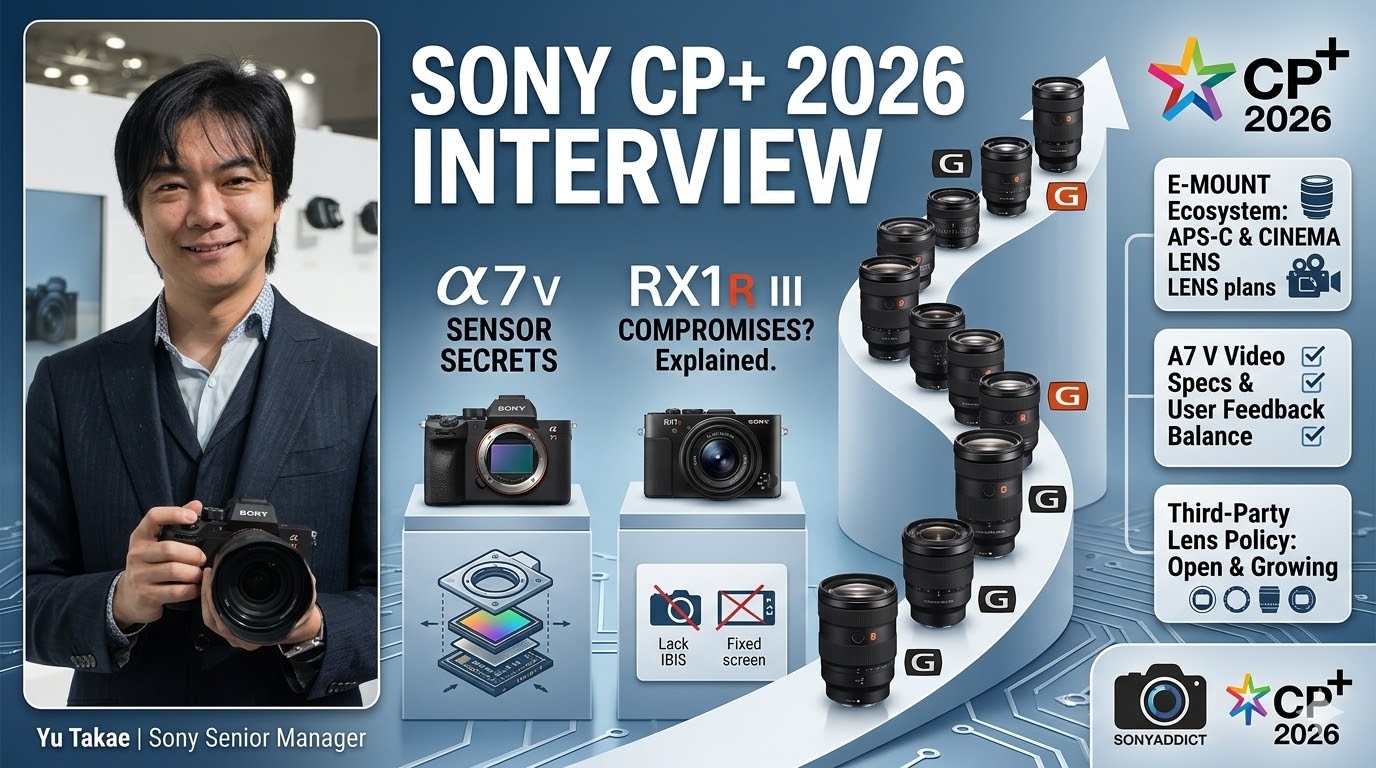
At this year’s CP+ event, Sony’s Yu Takae sat down with Phototrend to discuss the monumental (and delayed) launch of the A7 V, the surprise resurrection of the RX1R III, and the future of E-Mount. But the real story isn’t just what Takae said; it’s how he defended Sony’s recent controversial choices. Why is the A7 V playing it so safe with video specs? Why did we wait a decade for an RX1R III just to get a fixed screen? Takae had some answers, but as always, the devil is in the details. Here’s the complete translated interview breakdown.
The Sony Alpha 7 V (α7 V) & Sensor Tech
- Sales Performance: Since its release, the α7 V has seen strong sales across all regions.
- Release Delay: When asked why the α7 V was delayed and why the update to the α7 IV took so long, Sony declined to give specific reasons. They noted that release dates are determined by taking a variety of factors into account.
- BIONZ XR2 Improvements: The new processor significantly improves battery life and heat dissipation performance. However, Sony has chosen not to disclose the specific technology or architectural details behind it.
- The “Partially Stacked” Sensor: This new sensor design allows the α7 V to achieve a readout speed that is approximately 4.5 times faster than its predecessor, the α7 IV.
- Achieving 16 Stops of Dynamic Range: Sony confirmed that this impressive dynamic range is driven by the new partially stacked CMOS sensor, though they kept the exact technical details a secret.
- “Conservative” Video Capabilities: When asked if the α7 V’s video specs were intentionally limited to protect their cinema line, Sony stated that product specifications are determined by considering overall value and balance. They emphasized that the camera has been very well received by video creators, and that user requests will be reflected in future product plans.
The Return of the RX1R III
- Revival After 10 Years: Why bring it back now? Sony explained that the revival was directly due to numerous requests from professionals and top creators who specifically wanted a successor to the RX1R II.
- Lack of IBIS and a Movable Monitor: Addressing the criticism regarding the lack of in-body image stabilization and an articulating screen, Sony gave a standard corporate response: specifications were determined by taking into consideration the overall balance of the product.
APS-C and the Alpha 7S Series
- The Future of APS-C: Is the APS-C line being scaled down or discontinued? Sony says no. The α6700 and α6400 continue to receive high praise and maintain stable sales. While they won’t comment on future plans, they are closely monitoring market trends and user feedback.
- A Successor to the α7S Series?: The α7S line is still actively used for both photography and video, maintaining stable sales. Sony will continue to consider a successor while monitoring the market, but no specific plans have been made public yet.
E-Mount Ecosystem & Third-Party Lenses
- Future E-Mount Plans: The E-mount system will continue to be expanded to meet the diverse needs of creators. Sony aims to support creativity through products that offer new value, though they will not disclose specific upcoming product plans.
- Relationship with Chinese Lens Manufacturers: When asked if their relationship with newer Chinese lens makers differs from traditional third-party manufacturers like Sigma or Tamron, Sony declined to comment on individual companies. They reiterated that the basic specifications of the E-mount were made public in 2011, and that policy remains entirely unchanged. With many manufacturers using these specifications, Sony’s goal is to continue expanding the E-mount ecosystem.
When Sony says the A7 V’s video specs were determined by “considering overall value and balance,” what they actually mean is: we don’t want to cannibalize our FX line. It’s a slightly frustrating reality, even if the partially stacked sensor’s 4.5x readout speed and 16 stops of dynamic range make the A7 V an absolute powerhouse for hybrid shooters.
As for the RX1R III? Blaming the lack of IBIS and an articulating screen on “overall balance” is a tough pill to swallow when you’re dropping over $5,000 to compete with the Leica Q3—especially when the A7C R exists in our ecosystem. Still, putting 61 megapixels of flagship A7R V tech into a camera the size of a teacup is an engineering marvel that we can’t ignore.
But what do you guys think? Is Sony holding back the A7 V too much on the video front? And is the RX1R III’s purity and size worth the premium, or are you sticking to your A7C bodies?
via Phototrend