



A new Patent was found for a Tamron 28-70mm f/2 zoom lens. Previously, there was a Tamron 28-70mm f/2 patent found here, but this one is a new one that is slightly different with a more refined and compact design, which you can check out below with a brief comparison between the two patents:
Tamron’s latest patent P2025163723, published October 30 2025, builds on the company’s earlier filing P2025131290 from September. The earlier application outlined a family of large-aperture zoom designs ranging from 28–70 mm F2 to 25–200 mm F2.8–5.6, describing a common optical framework that could scale to different focal lengths and brightness levels.
The new patent narrows that concept down to a single purpose-built 28–70 mm F2 lens, refining the optical layout to improve compactness and reduce focus-group mass while keeping the same high-speed performance. In other words, P2025163723 is a focused evolution of the multi-range design first revealed in P2025131290—an indication that Tamron may be fine-tuning this bright standard zoom for production.
overview
- [Publication number] P2025163723
- [Release date] 2025-10-30
- [Title of Invention] Zoom lens and imaging device
- [Application date] 2024-04-18
- [Applicant]
[Identification number] 000133227
[Name or company name] Tamron Co., Ltd. - The present invention aims to provide a zoom lens that has a large aperture ratio yet allows the entire zoom lens to be made compact, and in which various aberrations are well corrected over the entire zoom range, and an imaging device equipped with the zoom lens.
- [Background Art]
[0002]
Imaging devices using solid-state imaging elements, such as digital still cameras and digital video cameras, are widely used. Interchangeable-lens imaging devices, particularly single-lens reflex cameras and mirrorless cameras, allow users to capture images with various angles of view, brightness, depth of field, and other characteristics by simply changing lenses. In recent years, large-aperture lenses have become desirable for these interchangeable lenses, enabling them to take advantage of even greater brightness and blur. Conventional zoom lenses often have an F-number of around 2.8, even at their brightest. Those seeking a lens brighter than this often have no choice but to choose a prime lens. However, because prime lenses have a fixed focal length, they have drawbacks such as a limited capture range, the hassle of changing lenses to change to a different focal length, and the need to carry multiple lenses with different focal lengths. To solve these problems and improve convenience, large-aperture zoom lenses are desirable. - [0003]
Furthermore, with the increasing popularity of compact mirrorless single-lens cameras that do not have mirrors or optical viewfinders, there is a demand for compact cameras as well as compact lenses. However, when attempting to realize a zoom lens with a large aperture ratio, the lens diameter and aperture diameter become large, and the overall length of the zoom lens also becomes long. Furthermore, the drive mechanism and other components also become large, which results in a problem of the overall size of the lens unit, including the lens barrel. - [0004]
To achieve a compact zoom lens, it is necessary to reduce the aperture diameter, the diameter of the lens closest to the object, and the diameter of the lens closest to the image, as well as the overall length of the zoom lens. In addition, to achieve a compact lens unit, including the lens barrel, it is desirable to embed the focus drive mechanism, aperture unit, and various mechanical components in a location within the entire lens unit, including the lens barrel, where the optical system has a small diameter. Therefore, it is necessary to provide an area in which lenses with small outer diameters are located. Furthermore, if the focus group is heavy, a drive mechanism with a large drive force is required, making it difficult to achieve a compact lens unit, including the lens barrel. Therefore, it is also necessary to reduce the size of the focus group. - [0007]
Here, Patent Documents 1 and 2 are known as examples of positive-lead zoom lenses with a large aperture ratio and an F-number of about 2.0. Patent Document 1 proposes, for example, in Example 1, a zoom lens with a large aperture ratio and an F-number of 2.06, which is composed of, in order from the object side, a first lens group having positive refractive power, a second lens group having negative refractive power, a third lens group having positive refractive power, and a fourth lens group having positive refractive power. Patent Document 2 also proposes, for example, in Example 1, a zoom lens with a large aperture ratio and an F-number of 2.06, which is composed of, in order from the object side, a first lens group having positive refractive power, a second lens group having negative refractive power, a third lens group having positive refractive power, a fourth lens group having positive refractive power, and a fifth lens group having negative refractive power. - [0009]
However, in the zoom lens of Patent Document 1, although the image-side lens in the second lens group has a relatively small outer diameter, lenses with high axial ray heights and large outer diameters are arranged consecutively from the third lens group to the fourth lens group toward the object side. As a result, it becomes difficult to secure space for arranging the focus drive mechanism, aperture unit, and various mechanical components in a small-diameter position within the entire lens unit, including the lens barrel, resulting in a problem of the entire lens unit, including the lens barrel, becoming large. Furthermore, the second lens group, which is the focus group, has a large number of lenses (five lenses), which makes the focus group heavy, requiring a drive mechanism with a large drive force, resulting in a problem of the entire lens unit, including the lens barrel, becoming large. - [0011]
The present invention has been made in view of the above circumstances, and aims to solve the above-mentioned problems and to provide a zoom lens that allows the entire zoom lens to be miniaturized while maintaining a large aperture ratio, and in which various aberrations are well corrected throughout the entire zoom range, as well as an imaging device equipped with the zoom lens.
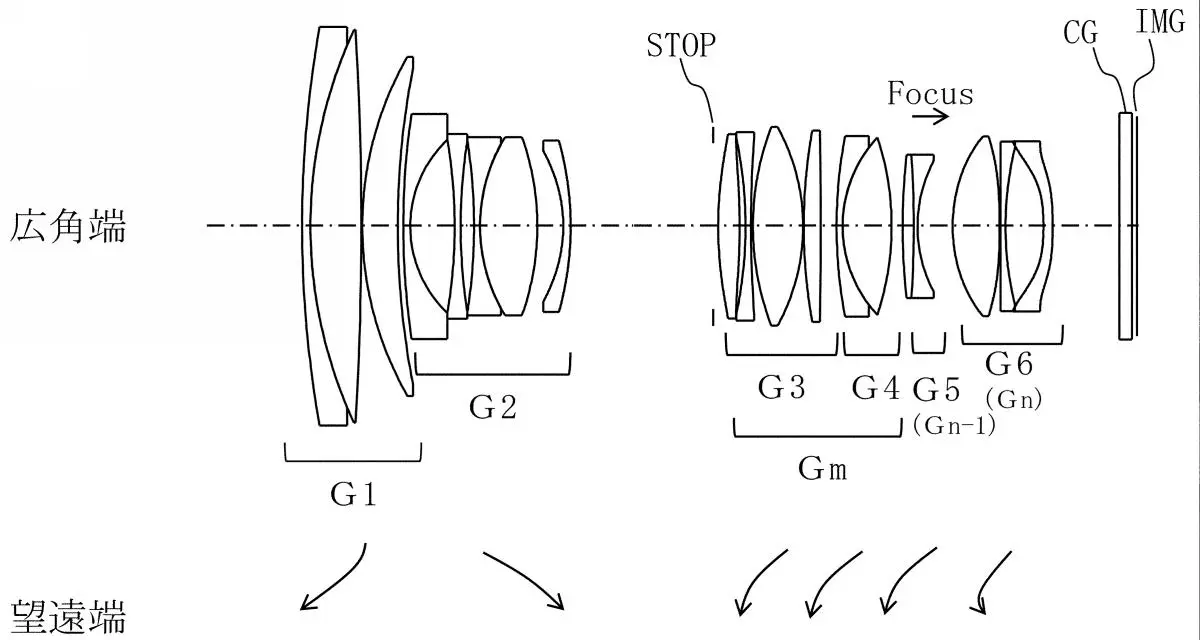
Example 1
- Focal length: 28.85-67.90
- F-number: 2.06
- Angle of view: 74.9-33.8
- Image height:
- full length:
- Back Focus:
via asobinet